by: Jean F Hankins
The date of January 1, 1785, is important in Maine history because it marks the start of Maine’s struggle to separate from the Commonwealth of Massachusetts. More specifically, it was the date of the first issue of Maine’s first newspaper, The Falmouth Gazette, published in Portland. The entire issue was devoted to explaining why separation was necessary: The three most important were, it reminded its readers, that Maine and Massachusetts, it reminded its readers, had different history, situations, and needs; second, Maine taxpayers would get a break if it were no longer yoked to Maine; and, finally, on achieving statehood Maine would count as one more anti-slavery vote in the U.S. Congress. These arguments were to be repeated, with variations, for 35 years. In many of Maine’s inland towns, however, the reasoning of the Gazette editors fell on deaf ears.
It did so in Otisfield. In 1785 Otisfield was still in the throes of becoming incorporated. Its bounds had been established in 1771 when it was granted to a group of Boston proprietors. It would be five more years, 1776, before it even had a formal name, in recognition of the importance of the Otis family, one of the larger proprietorial shareholders. But 1776 was hardly an auspicious time to draw up maps, lay out and sell lots, or build roads, bridges, and mills, all necessary first steps in establishing a new town. A few hardy individuals squatted in the area before the Revolution ended, but not until 1783 were the first four lots actually sold to new settlers. In that year, just as the Gazette was inaugurated, Otisfield’s proprietors, meeting as always in Boston, were voting to give David Ray a piece of land in exchange for building a mill, the most essential building for any new town. In 1785, no one in Otisfield had access to a Portland newspaper, and its handful of pioneer settlers probably regarded the political scene in Portland, 40 miles distant, as of no practical concern. News from Portland and the coast reached them only by word of mouth.
In Portland the cause of separating from Massachusetts was led originally by the movers and shakers—all Federalists—who had always managed Maine’s affairs, and profited from doing so. These leaders constituted a small clique of newspaper publishers, merchants, wealthy farmers, and college-educated ministers, all of whom were also had something to gain as speculators in Maine’s growth. They did not include the debt-ridden farmers, many of them Revolutionary War veterans, like those moving into Otisfield and the other new towns. David Ray, the first miller, for example, was born in Wrentham, Massachusetts, and served as a Minute Man in April 1775 and subsequently in several of the major Revolutionary expeditions in Massachusetts and New York. He moved to Otisfield in 1780 and was soon operating the mills so vital to the fledgling community. An Otisfield village and road now bear his name. Like Ray, the early Otisfield settlers formed a homogeneous group, mostly of English stock, Protestant, mostly Massachusetts natives. Many had fought in the Revolution.
The Maine separationists were a more sophisticated, better educated group. Probably their most important leader was William King, later to become Maine’s first governor. He was born in Bath to a shipowning merchant and attended not just local schools but also Phillips Academy, then, as now, located in the Massachusetts town of Andover.The group he spearheaded had to fulfill two basic conditions in order for Maine to become a separate state. First, the Commonwealth had to agree to this, and, second, a majority of Maine’s voters, including those in Otisfield, had to agree as well. The second of these conditions was by far the harder to achieve. Although led at first by members of the Federalist party, the separation movement soon became an uneasy coalition of the dominant Federalists centered in Portland and the larger coastal towns, and, increasingly, the more numerous inland farmers and settlers. The effective procedure leading toward separation involved not just newspaper editorials but conventions, trial voters, and petitions. It proved to be slow and unpredictable. Otisfield voters, as things turned out, were among the least predictable and, from our point of view, some of the most interesting.
Almost immediately after the publication of the first issue of the Falmouth Gazette, two events outside Maine caused major problems for the separationists – Daniel Shays’s uprising and the passage of the federal Coastal Law in 1789. Shays’ rebellion occurred in 1787-88, only a few years after the end of the American Revolution. Shays spearheaded a group of debt-ridden farmers from western Massachusetts demanding that the Massachusetts General Court provide them with legal or monetary relief from the numerous farm foreclosures then taking place. Among other reforms they argued for a change in the monetary system to paper. The group eventually consisted of 1300 men who marched on the federal arsenal at Springfield before being being routed by the state militia. Several were killed. Whatever sympathy Mainers had for Shays’ grievances, most were alarmed by the possibility of another armed uprising against civil authority. Historians have concluded that this “startling new event” profoundly affected the [Maine] movement to separate.” It caused the Federalist supporters of the separation movement to fear that the bulk of their support might be coming not from the “respectable” part of the population but from the “dangerous” elements in interior Maine.
The second event that weakened support for separation, particularly among the Federalist leaders, was the passage in 1789 of the U.S. Coasting Law. This law stated that a vessel sailing along the Atlantic coast “must enter and clear at the custom house both coming and going in every state except for states it was contiguous to.” Here Massachusetts had a big advantage over most states. Because of its odd geographical boundaries, its ships had uninterrupted sailing as far south as New Jersey because the Bay State was contiguous to the states of New Hampshire, Rhode Island, Connecticut, and New York. And as long as Maine was part of Massachusetts, its cargo ships enjoyed the same privileges. Mainers’ objections to any change in their status under the Coasting Law was not that separation would cause their fees to increase substantially but that independence would make their ships subject to long delays and frequent interruptions in what could otherwise be a nonstop voyage. Then, as now, time was money.
The effect of Daniel Shays’s rebellion and the Coasting Law was to destroy most of the enthusiasm for separation among Maine’s Federalists and its coastal population. A March 1789 separation convention in Portland drew only 3 delegates. The results of the formal votes held in Maine towns for separation also reflected this diminished support. In 1792 Maine’s voters were asked if they wanted to separate. Despite a growing population of 96,540 in Maine at the time, only 4600 chose to vote. Of those, only 2074, less than half, agreed.
Closer to home, in Otisfield, we find that the local voters also weighed in on the question of separation. In April 1793 Otisfield had its first chance to vote on the issue. (Otisfield was then not an incorporated town but held interim “plantation status” until 1798, when it became incorporated as an official Massachusetts town.) Although Otisfield’s 1793 population was then about 197, and of course only men could vote, only 22 did so. Unlike Maine voters as a whole, 21 Otisfield men strongly favored separation; only one voted against.
The results of the 1792 and 1793 votes in the state of Maine and the town of Otisfield indicate that while most of the rest of Maine voted against separation, Otisfielders took the opposite tack and enthusiastically supported it. These 1793 results are the beginning of a local voting pattern that is strikingly inconsistent with that of other inland Maine towns. On May 10, 1797, Otisfield even more emphatically voted for separation, with 32 for separation and none against.
Meanwhile, in the District of Maine as a whole, the separation movement was faltering. In 1793 only fifteen towns and plantations sent delegates to meet at Portland. A 1794 convention was virtually ignored. A 1797 referendum on statehood for Maine did return a narrow margin in favor, but only 5000 bothered to vote.
By 1800, then, the Maine separation movement looked pretty dead, lacking support from the Federalist party and unable to muster much enthusiasm from inland towns which had quite different concerns. But, as it turned out, the pro-separation spirit was dormant but still alive. In this second period of the separation movement, several new factors came into play that renewed Mainers’ interest in achieving independence. The first was the change in the size and nature of Maine’s population. Another was the ascendancy of a new political party, the Democratic Republicans, and with the new party, new and more effective leadership. The third, and probably most important difference maker, was the War of 1812.
The population of Maine surged between 1790 and 1810. In 1790, the first federal census counted 96,540 in the District. By 1800 the number was 150,000, an increase of 57 percent. By 1815 it totaled over 250,000. Most of the newcomers, including many Revolutionary War veterans, moved from Massachusetts and New Hampshire into interior Maine in order to take advantage of affordable farmland. Here Otisfield may be considered a fairly typical inland town. Its population swelled from a paltry 197 in 1790 to 450 in 1800, more than doubling. By 1810 it doubled again, up to 912. (Spurr, Fed. Census) Almost 200 new Maine towns were founded between 1793 and 1820. The new immigrants to Maine meant an infusion of capital, energy, and optimism. And “Sentiment for statehood grew as Maine’s population and economy expanded.”
About 1800, coincidental in Maine with the arrival of the newcomers was the rise of a new political party, the Democratic Republicans, as challengers to the well entrenched Federalists who, indeed, had been the only real political party. Nationally, the Democratic Republicans, often shortened to simply Republicans, were the party of Thomas Jefferson, just as the Federalist party is associated best with Washington and Adams. The Federalists were a socially conservative group who felt that strong government could best protect their financial interests and social status. (Leamon 176). The Democratic Republicans opposed the Federalists and soon became the larger political party in Maine. By and large they were small farmers, artisans, middling merchants, and other nonentities. The emerging leaders of the new party were the indefatigable William King, a veteran of the early separation movement, and a group of more recent settlers in Maine, including some centered in the new Oxford County (established 1805), among them Albion K. Parris.
The strongest argument for separation from Massachusetts was probably that Massachusetts still treated Maine like a colony to be exploited and was little concerned about Maine’s own interests or future. (It has always amazed me that none of Otisfield’s 25 or so early proprietors—first owners—of the large tract that became Otisfield ever set foot inside the town. For Otisfield proprietors like James Otis, all of whom lived in or near Boston, their holding Maine was purely a financial venture.)
The indifference of the Massachusetts government became most flagrant before and during the unpopular War of 1812, which, according to one historian, “opened wounds in Maine that were never to heal as long as union of the two peoples continued.” In 1807, during a trade dispute with Great Britain, the federal government placed an embargo on all exports, thus weakening the American economy and causing hardship for Maine’s shipping community. After war broke out, British troops seized control first of the islands of Passamaquoddy Bay and, three months later, the strategic port of Castine, which, as during the American Revolution, they administered as a conquered territory.
Immediately, Maine’s leaders, along with the federal government which itself was almost penniless, called on Massachusetts for military relief to repel the invaders. That plea fell on deaf ears. (Massachusetts, unlike the federal government, at that time had surplus funds in its treasury.)
Shockingly, the Massachusetts legislators turned down the governor’s request for aid to the District and instead funneled defense funds to mainland Massachusetts. Ronald Banks, the leading historian of Maine’s separation, concluded that “No event in the previous history of the union of Massachusetts and Maine so blatantly revealed the extent to which the interests of Maine could be sacrificed to those of Massachusetts proper.”
After the end of the fiasco of the 1812 War, the separation issue moved more quickly, but not always smoothly. The Democratic Republicans, still led by William King, doubled their efforts to build an effective organization, something that had not worked earlier. Even Federalists in Massachusetts began to see advantages to letting Maine go. Their main reason was that the Federalists’ hold on political control of Massachusetts was threatened by the fast-growing Democratic Republican party. With that party growing so rapidly, particularly in Maine, cutting away the District might mean the Massachusetts Federalists could keep continued control of the Bay State. Among those pushing this argument was Boston Federalist Harrison Gray Otis, later mayor of Boston, who owned considerable property in several Maine towns, including Otisfield, which had been named for his family.
In 1816 the Democratic Republicans mounted a new offensive to force the issue. In May the separationists meeting at a Brunswick convention were able to obtain a majority of 4000 votes, but the Massachusetts General Court ruled the number insufficient because it constituted less than half the eligible voters in Maine. A second convention in September was “disastrous for the separationists” who again failed to gain enough votes.
So where were the voters of Otisfield during this time, you may wonder. They were still sticking by their odd general principle of mostly ignoring the issue, but when they did have to decide one way or another, they were still casting votes that largely disagreed with the majority of Maine’s citizens. In the 1790s, you may remember, the tiny number voting in Otisfield favored independence by a large margin, about 20-1. By 1807, however, Otisfielders had completely changed their minds. Now no one at all voted for separation, and 47 against. Nine years later, In 1816, when the separationists’ cause had some chance of success, Otisfield remained adamantly opposed, with only 4 voting to separate and 80 against. I have no explanation, or apology for this pattern except to suggest that perhaps the voters of Otisfield were showing the same nonconformist spirit that erupted some 160 years later, in 1976, when the town successfully seceded from Cumberland County.
In 1816, for Maine voters as a whole, the cause of the logjam that stymied support for separation was the federal Coasting Law, discussed earlier, which was still in effect. Because that law threatened to penalize Maine traders financially if they became independent of Massachusetts, the seacoast communities were still voting against separation – even despite their outrage at Massachusetts’ war policies.
The breakthrough came only when William King travelled to Washington, D.C., and managed to convince key members of Congress to modify the Coasting Law. In March 1819 Congress passed a revised law which lumped all the states on the Atlantic seaboard into one customs district. With this change, nearly all opposition to statehood for Maine vanished, and the Massachusetts General Court quickly approved the separation act. But the decision still required the Maine voters’ approval, and that was not a foregone conclusion, as we have seen from the Otisfield examples. During the short interval before Maine voted, King and other Democratic Republican leaders established town and county groups to distribute literature and get out the vote, using electoral methods still effective today. In the July vote, although Otisfield’s population was then over 1000, only 70 of its men bothered to vote. Of them, 41 voted no. So in 1819 Otisfield was still acting as maverick, and fortunately most Mainers did not follow the Otisfield way. In that year Maine’s voters as a whole gave separation a landslide victory, approving statehood by more than 10,000 votes. Maine followed quickly by enacting a new state constitution, which was hailed as the most democratic state constitution to date in the United States.
That should have been the end of this story. It wasn’t. While the events of 1819 did separate the District of Maine from Massachusetts, Maine still needed federal approval for statehood. This too should have been a formality. But almost at the last minute, on March 3, 1820, Congressional approval of the statehood bill was jeopardized by a motion to amend the bill to include statehood also for Missouri. Suddenly this national issue polarized Congress, angered Maine’s delegates, and almost doomed statehood for both Missouri and Maine. At issue was the balance in Congress between slave-holding and free labor states. Various compromises were proposed: admitting Missouri as a free state, admitting Missouri as a slave state, and admitting Missouri as a slave state with gradual emancipation. At first the Maine contingent refused to consider adding another slave state under any terms. But for Congress as a whole, that compromise was the only politically viable way to save Maine’s bid for statehood. In a matter of days, largely through persistence and hard work, two Mainers, John Holmes and James Parker, hammered out the compromise package that Congress ultimately approved. Holmes adroitly secured the support of Henry Clay and Thomas Jefferson. Jefferson’s letter, published in a timely manner, endorsed the compromise. That may have made the difference. On March 15, 1820, Maine became the twenty-third state to enter the union. So ended a 35-year contest remarkable for its length and complex nature but remarkable also for its dependence on a democratic rather than military solution.
Two hundred years after the fact, I hope we all can take pride in the stubbornness and faith of Maine men like William King and John Holmes, who refused to give up when, time after time, their cause looked impossible. My other hope is that we as Otisfielders can act today to correct the historical record of our forebears who usually seemed to vote the wrong way. So I ask that we now give three cheers of hip hip hooray for the independence of the great state of Maine. At the count of three, please join me: One, two three, hip hip hooray, hip hip hooray, hip hip hooray!
Jean F. Hankins, Otisfield, Maine, July 25, 2020
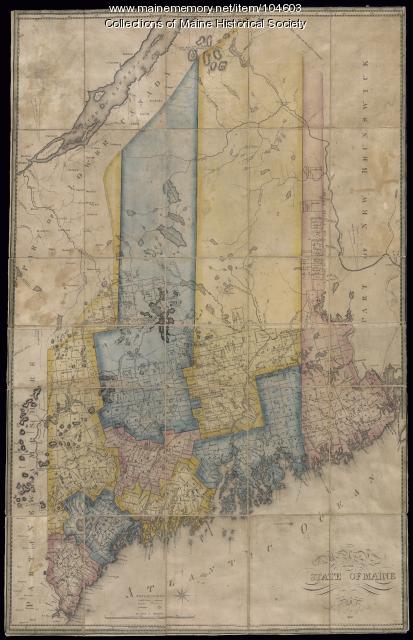
From the collection of The Maine Historical Society
Moses Greenleaf created this map in 1820, the same year Maine achieved statehood. The hand-colored map showed the county and township boundaries, along with land ownership.
Moses Greenleaf created several maps of Maine, with each addition more accurate and specific than the previous. William B. Annin engraved this map on a copper plate in Boston.
The western and northern boundaries of Maine later expanded.