written by Dr. Jean Hankins, for the occasion of the unveiling of the headstone for George Peirce
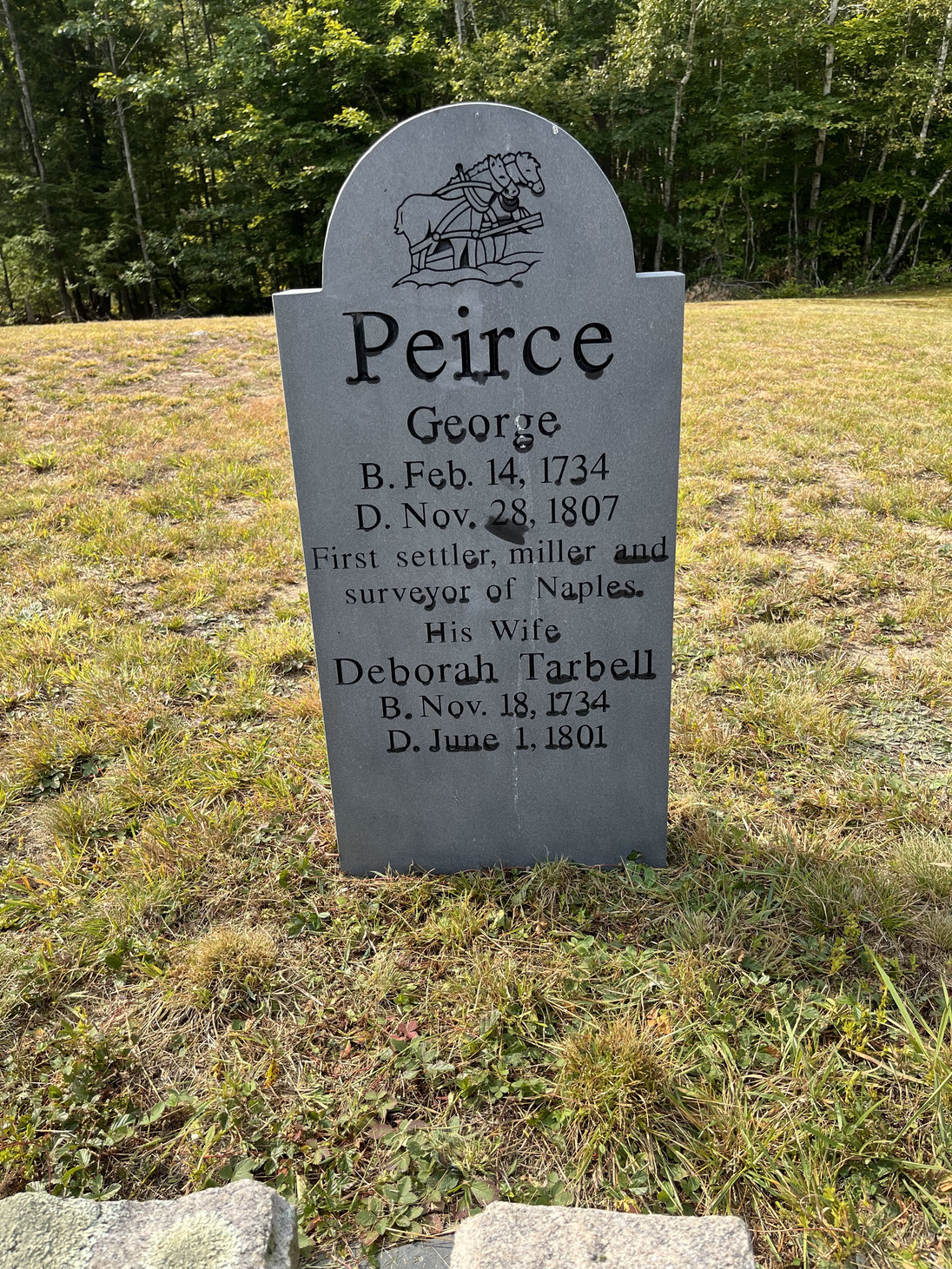
George Peirce was the first settler of Naples and also Otisfield. He arrived in 1775, shortly before the start of the American Revolution. He served as agent for a group of Boston proprietors to whom the Massachusetts General Court had given a township of unoccupied territory in the district of Maine as reward for their predecessors’ service in the disastrous 1690 expedition against Quebec. That territory now includes the towns of Naples and Otisfield. The man responsible for dividing, laying out, and even selling the new township was this first settler, George Peirce. He was born in Watertown, Massachusetts in 1734. His father, also named George, was, like him, a surveyor and in fact at one time had worked with an earlier group of proprietors whose 1734 grant, it turned out, was invalid because it was located in New Hampshire.
The 1774 contract of George Peirce stipulated that he was to build a saw mill and also a gristmill for the new town. He was paid 80 pounds cash, a goodly sum, and granted a deed to the mill lot, number 65. He was also given the use of the proprietors’ boat to ferry settlers and goods up the Songo and Crooked Rivers into what’s now Otisfield. The mills themselves were built at Edes Falls. Although well constructed, they lasted only a few years before a spring flood wiped them both out.
Creating the infrastructure for the new town was a huge job. It involved laying out and building the first bridge across the Crooked River in 1776, thus allowing for the expansion of the new settlement into what became Otisfield. During all the years of the American Revolution, Peirce spent laying out lots and establishing town lines as settlers trickled in. Although he had little medical training, he also served as local doctor, even setting bones and amputating limbs when necessary. Over the years he acquired several hundred acres of land in the new township. He was married twice and had a family of four children.
As years passed, the town of Otisfield’s population grew. In 1787 Peirce’s youngest child, Molly, then 19, became the object of a Scotsman’s unwanted attention. When the man, named McIntosh, assaulted her, Peirce rushed to defend her and was able to overcome the ax-wielding McIntosh by striking him with a heavy mallet. McIntosh died and Peirce was thrown in the Portland jail. Eventually he was acquitted of murder though convicted of manslaughter. Public opinion so favored him that his 8-month prison sentence was suspended and enabled Peirce to continue his ordinary civic duties.
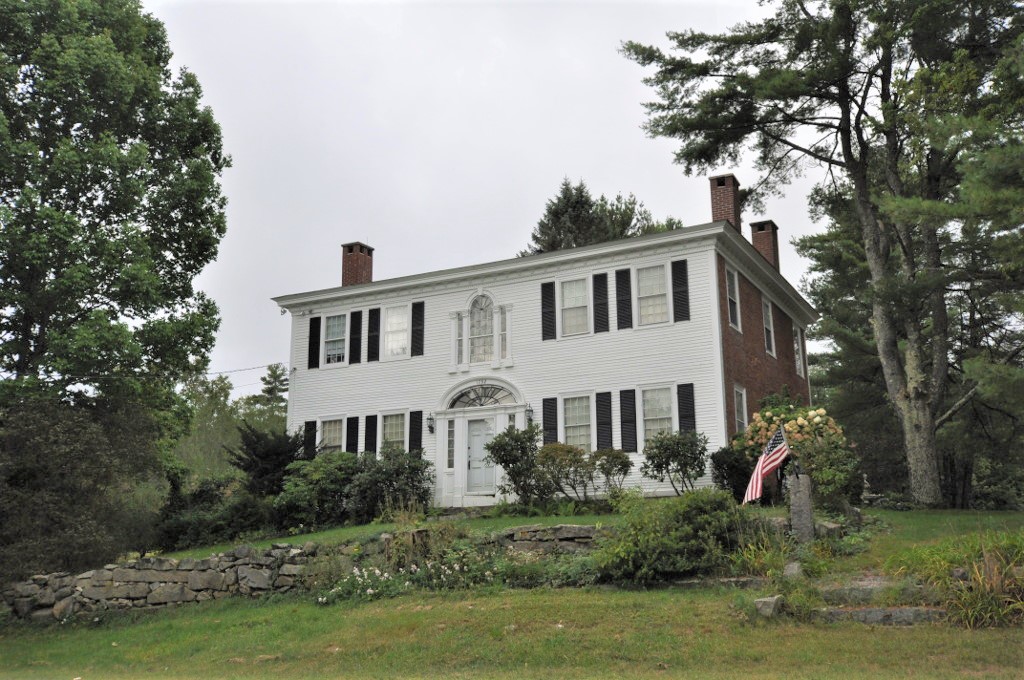
Despite this unfortunate episode, the citizens of Otisfield continued to look to Peirce to fill the leadership positions in the new town. After that town’s incorporation in 1798, he became the first constable and first tax collector. In 1792-3 Peirce built the large brick-ended house a mile north of Naples Village which one historian has called “one of the best houses ever built in this section of the country” (William Spurr, History, [p. 523). That is where we find ourselves today, probably not far from George’s burial site. About 1945, almost 80 years ago, William Spurr wrote this rather scathing comment on how Peirce’s burial site and gravestone had been treated: “Now, George Peirce, the founder of the towns of Otisfield, Harrison, and Naples, lies in an unmarked grave, and it should be a reproach to the people of those towns that he lies there without anything to mark his resting place” (Spurr, History, pp. 521-22). but today we can take pride that Spurr’s historical rebuke has been answered. Certainly his grave now serves as a lasting memorial to George Peirce, that remarkable pioneer and town founder.