Written by Polly Bartow, April 26, 2012.
The stencil has been used as an artistic tool for perhaps thousands of years and its use extends to various arts. Walls, textiles, books, games, furniture and countless other objects have, at one time or another, been decorated or maked by use of a stencil. The stencil itself is very simply a design cut into an impervious material such as paper, coated linen or acetate. Paint, ink, dye, or metallic powders are then forced through the stencil, usually by means of a brush or cloth, onto the surface being marked or decorated. Stenciling may be executed as a means of ornamentation, some of which can be argued crosses the line into fine art, or its use may be purely functional.
It is impossible to say when the first simple stencil was used. It is an extremely ancient tool which, by its very simplicity, may have come into use by many cultures at different times without necessarily being carried from one culture to another. Among the earliest historical evidences of stenciling is found on the island of Fiji in the South Pacific where for generations women decorated bark cloth with designs stenciled through openings cut in dried banana leaves.

Stenciling was used very early in China, at least as early as the T’ang Dynasty (618AD – 907AD). Stencils there were used in Buddhist monasteries to reproduce sacred texts and to decorate the walls of temples with religious symbols. The Mogao Grottoes nicknamed the Caves of a Thousand Buddhas in Gansu Province, China were decorated by use of stencils.
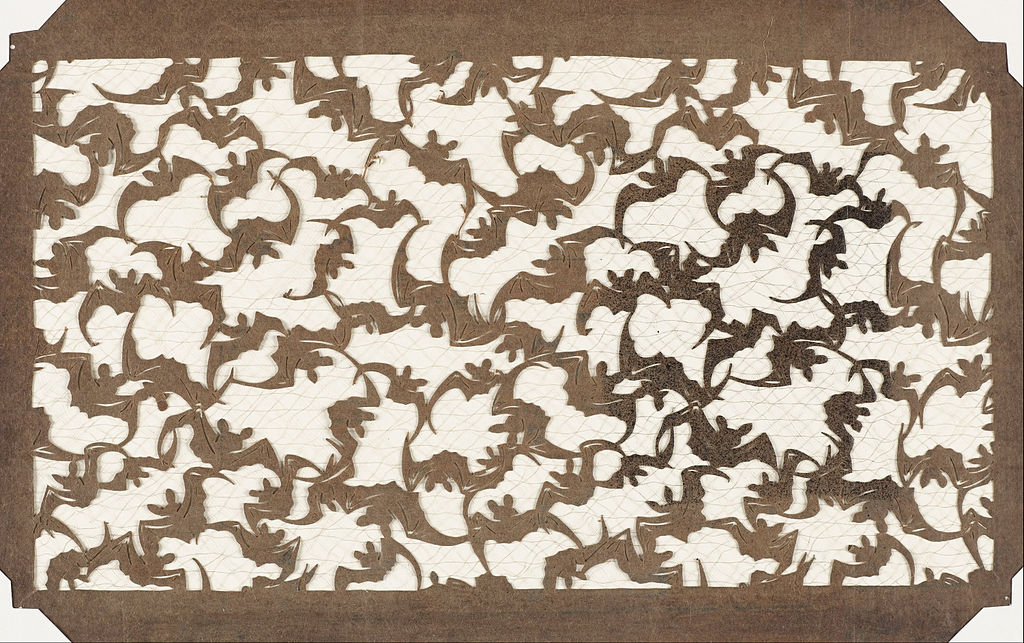
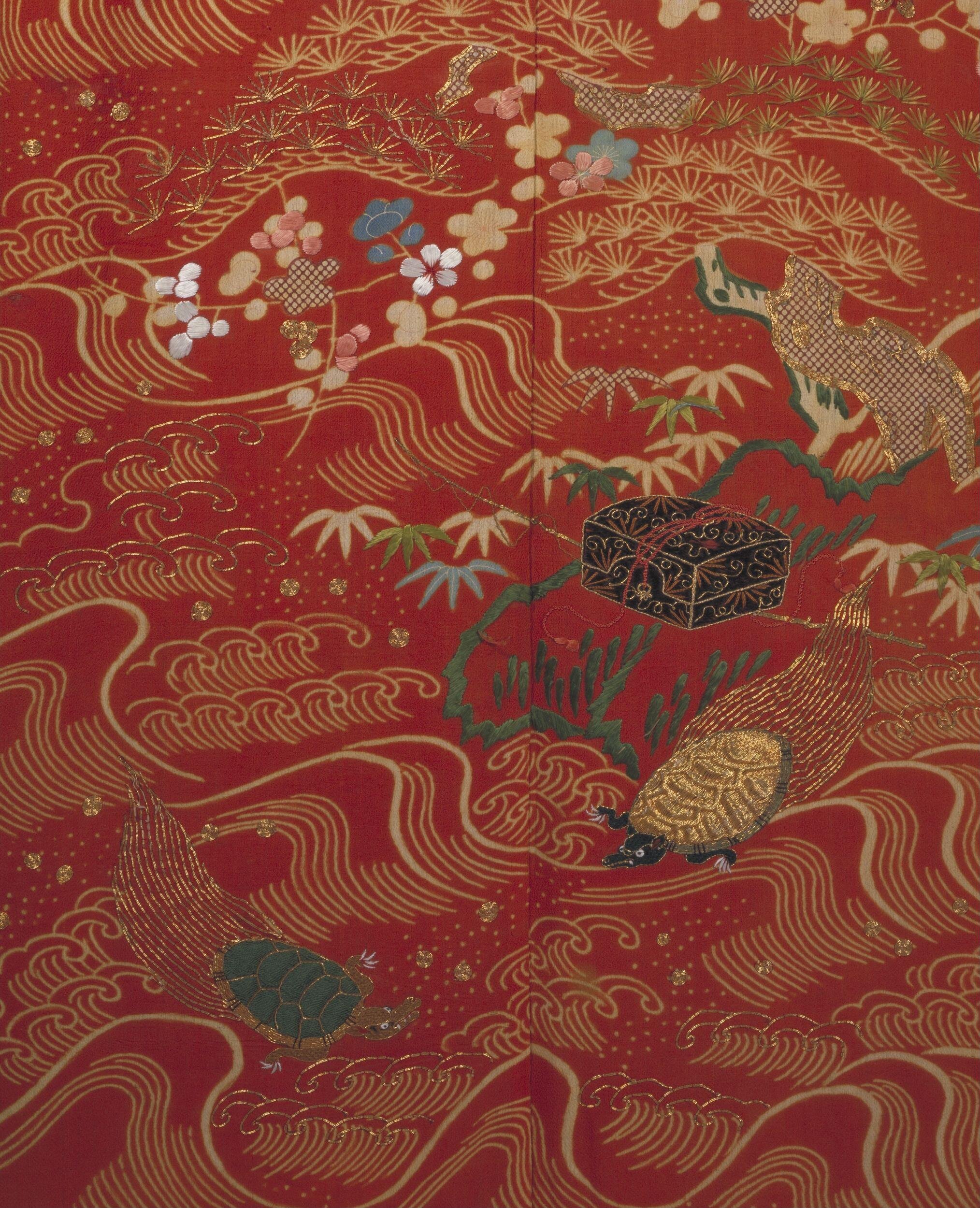
Japanese artists had developed the use of stencils to decorate silk textiles at least by the mid 8th century AD. A fragment of stenciled silk from this period which incorporates Buddhist symbols is in the collection at the Victoria and Albert Museum in England. Japanese artists also used stencils to create elaborate paintings on silk which are virtually indistinguishable from freehand paintings.
Very early stenciling is found in Europe as well. An interesting educational use was recorded in the first century AD by the Roman teacher Quintilian who used alphabet stencils to teach young boys to properly form their letters. The historian Procopius recorded that Charlemange signed his name with the aid of a stencil.
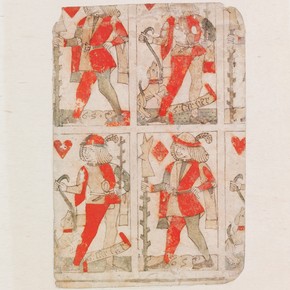
One of the first widespread uses of the stencil was in the production of playing cards. These were made in Germany, Spain, Italy and France beginning in the 1400’s. The image outline was block printed on paper and then the color was applied through a stencil. Wall hangings with a religious theme were also produced using this same method.
By the 1400’s, stencils were being used in France and England to decorate walls in churches and other buildings and by the late 1500’s, these decorations had become much more elaborate and were used in private homes on both interior and exterior walls.
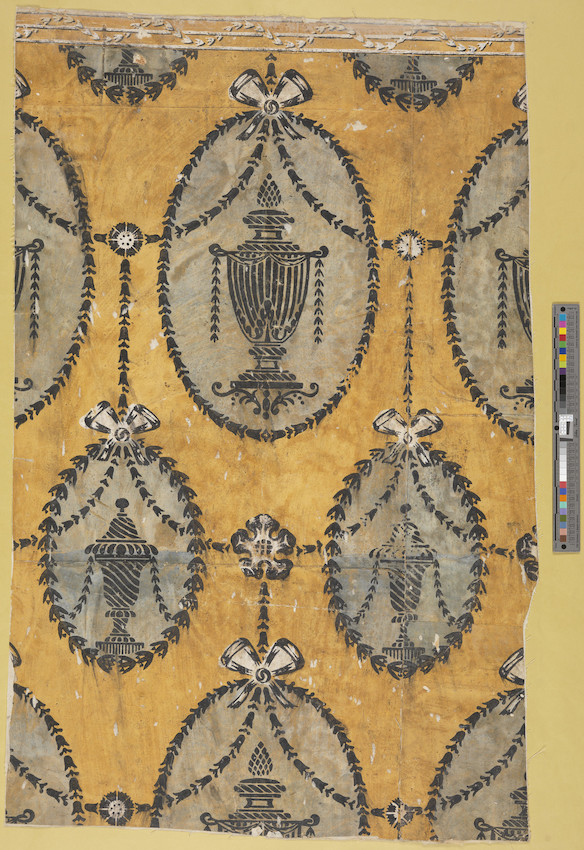
About 1688 stencils began to be used to decorate wallpaper. This earliest wallpaper was handmade in France of single sheets called dominoes using simple designs and few colors, pasted end to end to form a repeating pattern. This new mode of wall decoration quickly gained popularity and by the early 1700’s, more refined imported domino paper was being sold in Boston. By 1739, wallpaper was being made in the colonies and by the Revolution, was a luxury all the rage in places such as Boston, New York and Philadelphia among the wealthy few who could afford it.
Naturally, folks of more modest means in smaller towns and rural areas wanted to decorate their own homes with the beautiful patterns found in wallpaper panels and borders during the Federal period and so the itinerant painter rose up to meet this need. These itinerant stencilers traveled by horseback or on foot, some pushing carts and other carrying heavy packs filled with stencils, brushes, pigments and other tools of the trade. The common practice when hiring a stenciler was for him to first paint a sample of his patterns on an out of the way wall such as the inside of a closet. The family would then choose the patterns they liked best. The stenciler would often move in with the family while completing the project and sometimes his only pay was room and board. Some early stencilers were farmers and so the stencil work provided employment of a sort during the winter months.
We do not know exactly when homes in America began to be decorated with stenciling, however the earliest documented wall stencils are in Massachusetts. In 1778, when Abner Goodale went home to Marlboro to recuperate from wounds received in the Revolutionary War, he had five rooms in his home stenciled as a gift to his new bride, Molly. Among the motifs chosen was a very appropriate border of ribbons and wedding bells. This home is still standing and is owned by descendants of Abner and Molly.
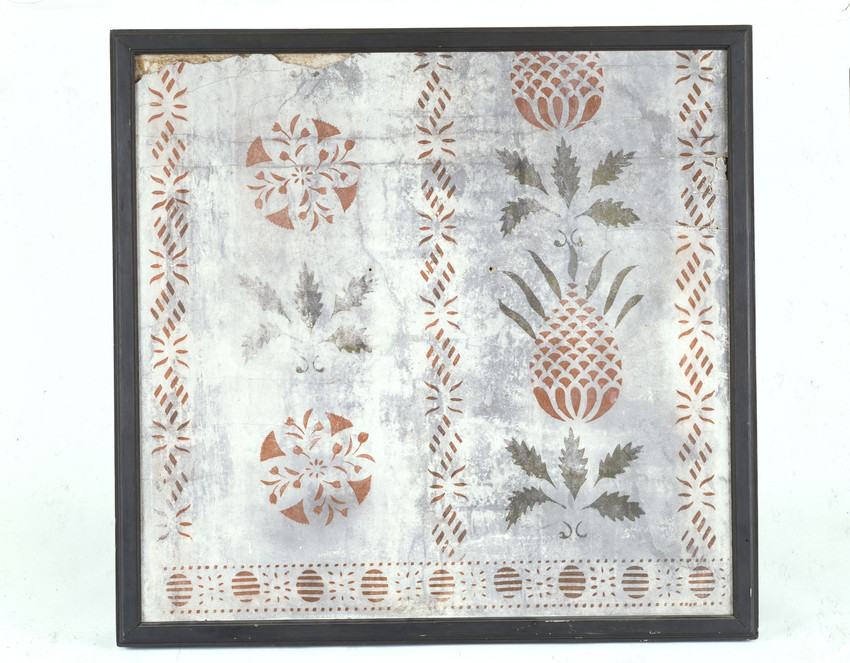
The colors used at the time were vibrant, not at all the muted tones that you might associate with stenciling. Antique stenciling you may have seen has almost certainly faded with time. Also, some pigments are more unstable than others and tend to fade rather quickly. Popular colors included vermillion, green, yellow and white. Wall colors themselves were often strong shades of pink, yellow or gray, however, some stenciling was done directly on the plaster. Some of the stencil motifs did have symbolic meanings attached to them. The swag and pendant was known then as the liberty bell and was considered a patriotic symbol, flower baskets represented friendship, the oak leaf, strength and loyalty, willows meant everlasting life and the pineapple, of course, hospitality. Hearts meant love and happiness and were often included in the decorations for a new bride.
Two of the best documented of the many New England itinerant stencilers who can be identified by name as well as by their distinctive designs are Moses Eaton and his son Moses Eaton, Jr. Eaton, Sr. was born June 19, 1753, served in the American Revolution and lived in Needham, MA near Boston until moving to a farm in Hancock, NH in 1792. By this time he was 40 years old and certainly seems to have kept busy with his stenciling near his new home. There are a number of homes in the Hancock, Dublin, Peterboro area with stenciled walls that were done by Eaton.
Moses Jr. was born in Hancock in 1796 and learned the art of stenciling from his father. Eaton Jr. began traveling the countryside in NH, MA and ME with his stencil kit while still a teenager. His known stops in Maine include Alewive, North Saco, Sebec, Sidney, Kennebunk, Falmouth, Waldoboro, East Vassalboro, Blue Hill and Buckfield.
In his twenties, Eaton met the muralist Rufus Porter, familiar to us because of the Rufus Porter museum in Bridgton. Porter was passing through Eaton’s hometown of Hancock, NH. The two apparently became friends and they collaborated on a couple of projects, the Hancock Inn in Hancock, NH and the Joshua Eaton House in Bradford.
When Eaton was 39, he bought a farm in Harrisville, NH near his childhood home. He married Rebecca Plant of Dublin, NH and they had three children. He decorated the parlor of his own home using red and green patterns and motifs on a soft raspberry background. In his later years he farmed and on occasion continued his stenciling journeys around New England. Eaton died at home in 1886 at the age of 90 and his descendants continued to live in the house until 2002. In 2005, Polly Forcier, a member of HSEAD and an authority on Moses Eaton stencils, restored the parlor walls for the new owners of the Moses Eaton house.
As mentioned earlier, there were a number of itinerant stencilers known by name who worked in New England during this period. Emery Rice was one of many who used stencils copied from Eaton’s work. Nathaniel Parker’s work is known in New England.
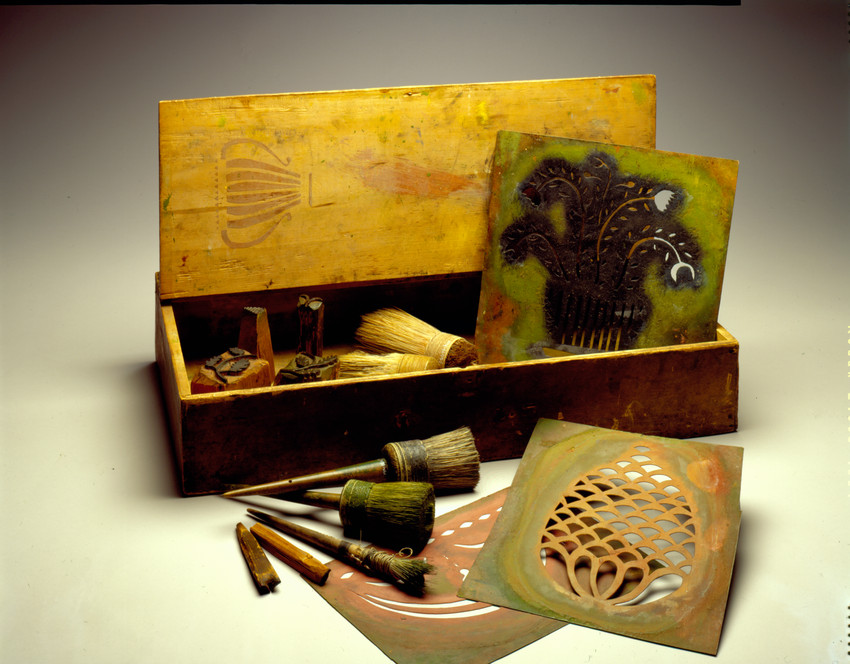
How do you know if you are looking at a Moses Eaton stencil? No written records have been discovered linking various design elements to Moses Eaton, however his stencil kit has survived. During the years when Janet Waring was researching her groundbreaking work Early American Stencils on Walls and Furniture published in 1937, she became friends with the descendants of Eaton’s daughter Mary. On one of her annual visits to the farm, she was given Eaton’s stencil kit as found in the attic of the home. The kit was a wooden box containing 78 stencils used to make 40 complete designs (some designs require more than one stencil). The designs range from a large weeping willow to small hearts, diamonds and circles used for the center of motifs. There were also 8 large worn brushes and a few wood blocks used to stamp designs on fabric. When Waring died, her sister gave the stencil kit to SPNEA, now called Historic New England. Waring as well as other researchers since, positively matched stencils from the kit to stencils found in various homes thus making it possible to link Eaton to the decoration in these homes.
Eaton’s stencils were made of very heavy brown paper which was stiffened with oil. Some stencilers painted or even shellacked theirs. Many of Eaton’s patterns were cut with a beveled edge to create a sharper outline and there is plenty of space around the cut out area to help prevent overrunning the stencil with the brush. Eaton’s stencils do not have register marks which means he simply “eyeballed” their placement. Polly Forcier describes his design as carefree and she explains that the overall placement of motifs on walls is often eyeballed as well rather than being laid out with a ruler.
It is known that itinerant painters often copied designs from one another, but each would have cut his own stencils. No two people will cut a design the same way, in fact any one person will cut the design slightly differently each time she does it, and so it is possible to match a stencil with the image produced by it and thus determine who probably executed the design. Or at least who stencils were being used! Eaton did have designs that seem to be unique to him and his followers and some that are typical only in Maine.
There are two distinct genres of early American stenciling: classical and Folk Art. Classical or “borderstyle” is characterized by graceful and elegant swags and festoons outlining the tops of walls along with complementing border designs that come down the corners and run along baseboards and chair rails. During the Federal period there was renewed interest in classical design and all things Greek and Roman sparked by the mid 18th century discovery of the ruins of Pompeii and Herculaneum. Classical style stencil motifs are very reflective of this neoclassical influence in federal period decoration.
The second style is folk art, characterized by an all-over design of motifs often borrowed from nature. Leaves, flowers, flower baskets, trees, birds, vines and other motifs are common. The designs are often primitive and naïve, but infinitely appealing. Moses Eaton’s stencil designs are among the best known of the Folk Art style. Motifs typical of Eaton include the weeping willow (with or without a bird), pineapple, flower basket (also with or without a bird), oak leaves, maple leaves, roses, sunflowers and vines. Various geometrics make up borders and basic elements to which a variety of central elements such as hearts or simple circles could be added.
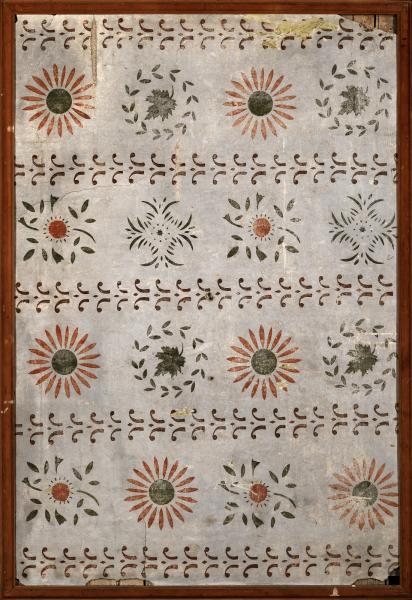
A sampling of Eaton’s work includes first of all this wall from the Mansel Alcock house located just one mile from Moses Eaton’s own home in Hancock, NH. Note the patriotic swag and pendant border (liberty bell) and the lovely flower spray. We’ll see this again later. Various botanicals include the running oak leaf border, the oak leaf spray and leaves and flowers topping the chair rail. Next is this wonderful fragment on plaster from the Smithsonian American Art collection. Note the beautiful sunflower motifs and other typical botanical elements.
The next example is a fragment that is part of the Historic New England collection. Note especially the pineapple and vertical border as you will see them again a bit later.
The final fragment, also part of the Historic New England collection, show lovely delicate botanical designs.
This brings us back to the question, how do you know if you are looking at stenciling executed by Moses Eaton? There is a house in Otisfield with lovely original stenciling that has been attributed to Moses Eaton Jr. so we’ll use it as a case study and see what we think. The house is the old Holden farmstead located on Oak Hill Road. The older part of the house is the cape with center chimney completed in 1812 by Roland Holden. The addition was put on in 1825. In his book, “Oxford County, Maine: A Guide to Its Historic Architecture” author Randall Bennett states, “ This well-preserved farmstead is particularly notable for its authentic early nineteenth century exterior qualities and for its interior wall stenciling attributed to Moses Eaton, an itinerant New Hampshire stenciler who probably executed them in the late 1820’s or early 1830’s.” So our first piece of evidence is that Eaton is attributed with painting the stencils in a book authored by a well known Maine historian. No mention is made in the book of who made the attribution so I called the author, Randy Bennett and asked. He explained that he never went in the house himself, but relied on information gathered by a volunteer who was told the Moses Eaton story by the homeowner. He is not aware of an expert ever having inspected the stenciling to authenticate the Eaton attribution. So not much to go on there.
My next step was to examine photographs taken of the stenciling by Otisfield Historical Society members as part of an architectural survey conducted in the town some years ago. The stenciling certainly has characteristics of Eaton’s work using known Eaton motifs in the typical all-over Folk Art design. Seen are the pineapple, weeping willow, flower basket, flower spray and borders similar to Eaton’s. The stencils photographed well and the paintings appear to be well done. Very encouraging!
As I studied the photos, however, one motif stood out, a pair of leaping stags positioned over a doorway. I couldn’t recall seeing the stag in lists of designs used by Eaton so I turned to my library of books on the subject, in particular expert Polly Forcier’s catalogue of Eaton designs and Janet Waring’s 1937 book on wall stenciling. The stag is not there. Knowing that my knowledge of Eaton’s work is incomplete, I contacted the real expert, Ms. Forcier and sent her the photo of the stag wall. She confirms that the stag is a mystery and, in her words, “ wonderfully curious”. She also commented that the frieze seen on the stag wall has echoes of Eaton’s work, but is not a replica of any known Eaton frieze. Hmmm- it seemed that this puzzle was becoming more complicated.
It was time to see the stencils for myself. On a pleasant evening not long ago, I paid a visit to the present owners of the Holden house, Sean and Claire Powell. They graciously answered my questions and invited me to see the stencils. Three areas downstairs have stencil decorations visible. The Powells were told that a fourth room is stenciled as well, but that area is wallpapered and they have been uneasy about removing it themselves for fear of damaging what may be underneath. All stenciling is in the older, cape-style portion of the home. I saw the central hall first. It has a pattern of pineapples alternating with floral sprays executed in panels separated by geometric borders. The stenciling is done in red and green on a yellow ground. Next, we moved to the front room to the right of the hall. This room was painted soft gray and the motifs used include the pineapple, weeping willow, with two styles of bird, flower basket, vertical borders to separate the panels and a lovely frieze. The stencil colors are red, green and yellow. Finally, we moved to a small room behind the front and there were the two stags over the door. The room is painted pink and the stencils include two styles of floral sprays, vertical border, trees beside the stags and a frieze. Colors used are red and yellow. The plaster walls themselves in each room are in fine condition and the original wall paint as well as the stenciled decorations are in very good condition exhibiting only expected wear. I examined them closely and the stencils in all three bedrooms are definitely original to the period.
The Powells explained the ownership history of the home and the story of the stencils as told to them by Dot Mayberry, one of the former owners. The present owners have lived there for 10 years. They purchased the home from a Johnston family who told them they owned the place for 20 years. The Johnstons bought the farm from Holden descendants. Dot Mayberry understood from family tradition that the stencils were done by Moses Eaton. I talked with one of Dot’s stepdaughters who told me Dot is still living, but in poor health. I have not been able to talk with her. So still no definitive authentication, but a wonderful family story and family stories usually have a grain of truth in there somewhere. I’ll come back to this.
Intrigued, and still faced with the mystery of the stags, I decided to put motifs from the Holden house side by side with known Eaton stencils to see how they compare. First up in the pineapple found in the center hall of the Holden house. The pineapple design seen here is not the one usually found in Maine, but does resemble the pineapple found in the house in North Saco done by Eaton. Close, but obviously not the same stencil. (The typical Maine design has three colors; it has a long curving leaf hugging the body of the pineapple, two leaf crowns, one inside the other, more and contrasting color eyes, and contrasting color strokes at the base).
Next is the flower basket in the front parlor room. Right away we see that the handles are missing in the Holden house, but otherwise it seems very much the same. In the same room are several weeping willows with bird, a common Eaton motif, but here the differences with known Eaton work is more striking. Eaton is not known to have placed his bird superimposed on the tree as we see here. He always perched the bird on top. There are two styles of bird in a willow tree in the Holden house and both are executed with the bird superimposed in the middle of the tree.
The border in the stag room is more promising. It looks identical to the stencil in Eaton’s kit. He apparently found this border design very useful as it appears frequently in homes known to have been decorated by him. Likewise the frieze in the front parlor seems identical as does the vertical border used in the hallway.
The yellow floral motif seen on the stag wall is very, very close. Examine it closely. Was it painted using the same stencil?
Finally, we have the unique stag design seen nowhere else in Eaton’s known work. Perhaps Eaton borrowed the stag stencil or cut one just for this house at the request of the owner. That could be. But taken with Polly Forcier’s comment about the authenticity of the frieze on the same wall and the obvious differences in some of the stencil motifs, I think there is room to question whether Eaton truly executed these absolutely stunning designs.
But what about the family story passed down from owner to owner which attributes the painting to Moses Eaton? Perhaps Eaton is the true artist, but maybe there is another explanation. When all things Early American was undergoing one of its periodic surges in popularity in the early 20th century, any old wall stenciling became known as Moses Eaton style or simply Moses Eaton stenciling. Think of a Kleenex. It is more properly called a facial tissue that may or may not be made by Kleenex, but we call it a Kleenex because that company is the most well known maker of the product. The same was true of stenciling done in the Moses Eaton style. By the early 20th century, Eaton was the most well known stencilier because he was so well documented, but he was by no means the only man doing quality work in New England. There were many and some whose work was more finely done than Eaton’s.
Polly Forcier offered that as a young man, Erastus Gates learned from more experienced Eaton and used many of his designs, cutting his own stencils. Gate’s territory overlapped Eaton’s so it is possible that he made his way to Otisfield. There were many others who copied Eaton’s designs and we may never know for sure who decorated the Holden house. What is certain is that these are beautifully painted and well preserved fine examples of early 19th century Folk Art stenciling in the Moses Eaton style. They are most worthy of our attention. Otisfield is lucky to claim them as part of the history of the town.
With industrialization beginning in the 1840’s, wallpaper soon became mass produced by machine at prices that were affordable by nearly any homeowner. Wallpaper enjoyed a new surge of popularity and homeowners eagerly papered over the hand painted stencils suddenly seen as shabby and unsophisticated. Luckily, not all stenciled walls were papered over and even if they were, the paints used in early stenciling very often survives the wallpaper treatment and careful removal of old paper even now may reveal the wonderful surprise of original stencils underneath.
A new interest in American Folk Art of the 19th century arose in the 1920’s and 30’s and individuals with the means to do so such as Abby Aldrich Rockefeller, Mrs. John D. Rockefeller, Jr. and Nina Fletcher Little began to amass huge collections of such things as samplers, quilts, and decorative arts including stenciling. When these private collections were made public, the average person started to become interested in so-called “early American” decoration. The work of researchers such as Janet Waring and Nina Fletcher Little ensured that early decorative art such as stenciling received the serious attention it deserved. Groups such as the Historical Society of Early American Decorating preserve original pieces and pattern designs and teach traditional decorating techniques in the hope that this knowledge is not lost forever.
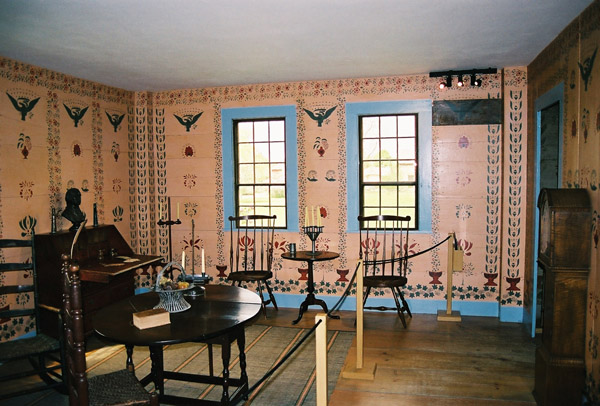
You can see lovely original stenciled walls in the Stencil House and Dutton house at the Shelburne Museum in Shelburne, VT and at the Brick Store Museum in Kennebunk.